Showing posts with label HCF. Show all posts

Wednesday, November 13, 2019

Mandate of TMS

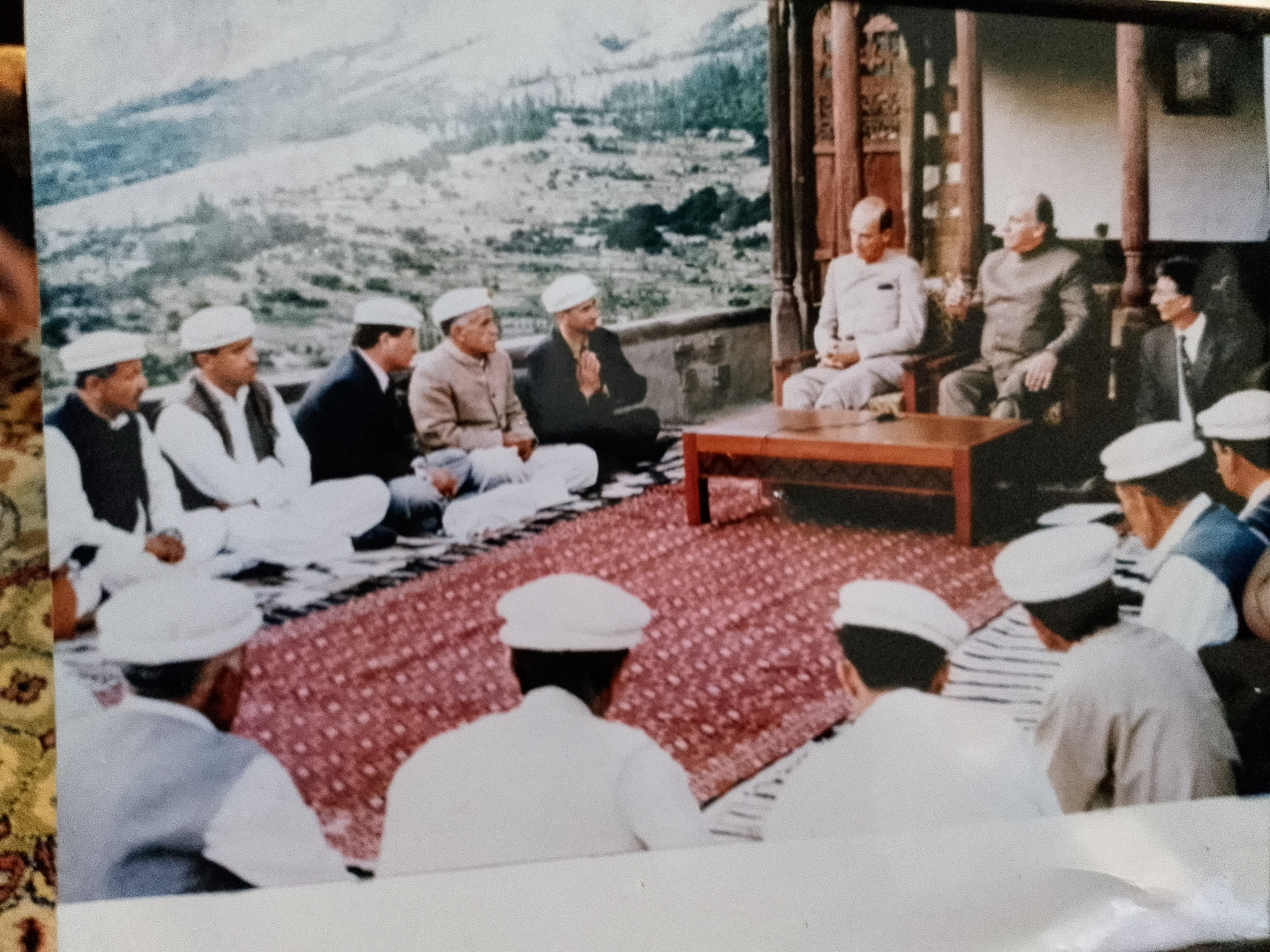
His Highness' Speech at the TMS Meeting at Baltit Fort.


https://hisamullahbeg.blogspot.com/2019/10/mandate-of-tms.html

First of all I would like to tell the Town Management Society, how happy I am to be able to meet with you on this really unique day when, for the first time, I am able to visit the restored Fort of Baltit. I would want to take this occasion to congratulate all those who have been associated with the restoration for the really wonderful work that they have put in to make this a successful restoration.
There are two ways of working, one with one's head only, and the other is to work with one's head and one's heart. I have to tell you that I sensed today that all team members who worked on this project have worked with their head and their heart, and I really would like to tell you how grateful I am, how happy I am.
I would like to take this occasion to illustrate to you why I think this is such an important initiative. The history of the peoples of the Northern Areas is under your control: it can be eliminated and forgotten, or it can be retained and used as direction and guidance in a number of different ways for generations ahead. It was my hope that this would be the use that you would make of your own history. History has multiple ways of being part of our everyday lives, and one of them is in the historic buildings that we have. Retaining these historic buildings, giving them a purpose from one generation to another, enabling them to inform us as to what were the principles by which previous generations lived; these are all elements of the greatest importance, and I am deeply happy to see that the Fort has not only returned pride in one building, but it has returned pride in the history of the people of Hunza. This is to me a very important aspect of the work you have been doing, and I am hopeful that what has been learnt from this restoration project will become part of Hunza's society.
As you look at your old buildings, you will want to retain them and give them a modern purpose in life. Now the nature of life has changed, and Hunza has changed. There are two ways to look at change: one is to let it build up its own momentum in many different ways, but the benefit is likely to be dubious and diluted and there may be negative repercussions. The other way is try to understand and forecast the nature of change and have that Change work for you. And that is what I am hoping for, in the way you think about planning in the town of Karimabad, and other towns in the area. That is: let the processes of change occur but manage them, forecast them, make them work for you.
Now this is a new concept. A hundred years ago there was no question of large number of visitors coming to, Hunza every year. The younger generation wasn’t receiving the type of education it is receiving today. Today, there are new requirements, there are new needs, and the important thing is to create a consensus around one objective: that those processes of change should bring new quality of life to you and the future generations that live here. And the only way to do so is to try to identify what are the positive aspects of the processes of change and what are the negative aspects. Remember they very rarely come independently one of the other. They will nearly always, come together.
So while looking at the opportunities of change, be careful of the risks of change and in the work that you are doing. There are both aspects: risks and opportunities. Risk management means identifying the areas where change could be damaging to the traditional way of life, to maintaining history, to maintaining the overall atmosphere and quality of life, Opportunity is letting the change benefit. Now if you locate those, benefits in various areas of your environment, you will find that they will become beneficial to everyone. The effect may not be recognizable immediately. But in the long run they will help everybody, because more and more people will find that the planning that you have done has been beneficial to them. This means that everybody has to collaborate in turning those opportunities to the positive side and in managing the risk.
I really wanted to share this thinking with you. Please remember that previously we have discussed income enhancements through improving everyone's resources, we have discussed improving health care through a primary health care and hospitals. We have discussed the improvement of basic education, and the training of teachers. Now we are discussing the physical environment; all that is part of the same goal, which is to improve the quality of life for people in the areas in which you are living.
I have simply given you some sense of the importance of this work. What I would like to do now is to listen to you, so that you can tell me whatever problems you have and I can think about them. I may not give you answers immediately, because sometimes I like to think a little bit more also as to what are the solutions. But basically, the important thing is to manage opportunity as it comes, so that you get the benefits of the opportunity and you contain the risks of change. This is what I am hoping for.
I think that you will be setting an extraordinary example. There are not many other places on the face of the earth with societies like yours, doing such things. So it is a new initiative. And Insha’Allah, with the intellect that you have, and with the knowledge we try to support you with, we will bring to this part of the world the knowledge of our time, but at the same time protect the past and enhance the future; that is really what we are seeking.

Speech by His Highness the Aga Khan at the UNESCO Conference on Culture and Development in Hangzhou, China

15 May 2013
Extracts:
“I am honoured by your invitation, and pleased for this opportunity to talk about two subjects that are very close to my heart – culture and development.”
“My attention to cultural legacies was triggered, over three decades ago, when I realized that the proud architectural heritage of the Islamic world was endangered. The art forms through which great Islamic cultures had expressed their identity and their ideals were deteriorating.
The result, for huge segments of the world’s population, was a fading of cultural memory. The world was threatened by an enormous cultural disaster.
Even worse, there were few resources for addressing this situation. Architectural thinking, globally, was dominated by western industrial models. Islamic architecture itself was abandoning its heritage in the face of an all-consuming modernity. 
Our response to that situation began with the creation, in 1977, of the Aga Khan Award for Architecture, dedicated to the renewal of this legacy. Soon afterward came the Aga Khan Trust for Culture, and under its aegis, the Aga Khan Historic Cities Programme.”
“The life of the neighbourhood has also been revitalized. Important initiatives in health, education and sanitation grew out of our quality of life assessments, and we continue to monitor quality of life indices, through baseline studies, on a regular basis.”
“For all of these journeys, the development process has been long and complex, but filled with stimulating lessons. Let me briefly summarize five of them.
First, these cultural projects depend upon an ethic of partnership. This means that traditional separations between public and private domains must be set aside. The concept of public-private partnership is an essential keystone for effective cultural development.
The role of governments, including municipalities, is fundamental in providing what we often term “an enabling environment” for development. But the public sector cannot do this work alone. A creative mix of participants is needed, corporations and development agencies, foundations and universities, individual donors, faith communities and local community groups.
I have one more comment to make about partnerships. It is absolutely essential that effective partnerships are maintained throughout the life of a project, including the post-completion period. Let me cite our own experience in support of this point. Of the 20 Historic City projects that we have undertaken, only two have failed the test of time. But in both cases what was missing was a strong partnership structure for post-project management.
This discussion leads me to a second conclusion: while cultural development often begins with physical legacies, planning must focus well beyond the cultural goals. We cannot somehow assume that a favourable social and economic impact will flow naturally as a by-product of cultural commitments. Issues relating to the quality of life must be considered from the beginning and monitored throughout the project's life.
A third point in this list of lessons learned is that the engagement of the local community from the earliest stages is imperative for success. Cultural endeavours, in particular, involve risks that go beyond external, economic factors. Their progress can depend heavily on variable qualities of human nature, including the pride and confidence of the peoples involved. In any development effort, there will be a tipping point along the way when we see the glass as half full rather than half empty. But these tipping points are more likely to tip in the right direction when attention to local confidence has become an ingrained reflex.
There is a fourth point that is also special to historic restoration projects. That is the fact that we can never be sure just what we will encounter as the work of rediscovery moves along. There are many unknowns going in, and we must be ready for surprises. I think, for example, of how little we knew, when we started, about the extent and condition of the Ayyubid Wall in Cairo, buried for 500 years or more. The Wall in fact had been so completely obscured that plans had been suggested for building a highway over it, until its remains were identified. In this case, as in so many others, the resilience and adaptability of all the partners, including the people of the local neighbourhoods, was critical.
Let me finally highlight a fifth lesson. Planning for such projects must anticipate how they will operate on a continuing basis after they are completed. In many cases, a permanent service facility will be put in place, a site museum perhaps, a scholarly centre, a children’s library, a training workshop, a clinical resource, or research facility. Financial planning must take these opportunities into account, as a set of costs to be sure, but also a potential source of revenue. Up-front investment will be on everyone’s mind at the start. But our financial strategies should include eventual income streams that will sustain the project over the long run. One of the least happy outcomes for any cultural initiative is that it becomes a net drain on the local population.”

Tuesday, December 18, 2018

Extract: Civil Society Learning Material on Gender equity

Context: Public statement by RC Gilgit and feedback on HCF page: "After the incident of girls dance in a TV show at Gilgit, women are protesting by sharing their dance videos...I am loving it, Rok sako to.roko" Kosar Bano

The ethical values that are important to the AKDN agencies are:

5. Gender equity

Wherever an AKDN agency finds that local CSOs do not exhibit these ethical values, it is the agencies’ role to help them, just as much as making sure that their governance and management practices are in place. The following pages suggest how the AKDN agency could investigate these subjects, and decide on action.
In many societies women are marginalised, exploited, and given few chances to acquire education, experience or the chance to show their strengths. The CSO should demonstrate that it has a different opinion and is prepared to put such opinions into practice.
Gender refers to the social differences between women and men that are learned through socialisation, and which are not intrinsic characteristics of each sex. In nearly all societies women are discriminated against, and in some countries such discrimination is underpinned by tradition, custom, laws and religious observances.
An enormous amount is lost to a society when women do not have access to education, jobs, decision making and responsibility. Even more is lost if this is underpinned by domestic physical and sexual violence.
What can an AKDN agency do encourage gender equity?
1. The AKDN agency can make sure that staff and volunteer positions are accessible to women as much as men, and when traditions and culture block this, can work to break down such practices and be a model as a fair employer with regard to gender balance.
2. Look for ways in which the agency and the CSOs with which it associates can overcome some of the difficulties that women have in overcoming structural problems – such as making sure crĂȘches exist for nursing mothers, and that transport (or security) is provided for women to come and go on CSO business.
3. Think of ways in which the usual imbalance of power between men and women can be re-aligned – e.g. by making evening classes available to women, giving them access to literacy materials, or making sure that they have access to credit.
4. As mentioned before, ascertain what organisations already work on gender equity issues and see if they can be helpful to your organisation.
5. Look for agencies, organisations, firms and government departments that are practising what you consider to be good gender relations, and hold them up as a model.
6. Have clear rules and regulations against abuse of women in your organisation, and practice zero tolerance for infractions.
7. Have services in place to help women connected to your organisation who may suffer from domestic violence or other physical and sexual violence.
GENDER EQUALITY
AKDN is committed to highlighting the key role of women in the development process and to facilitating their participation.  At the same time, it looks for ways to engage with men around the attitudinal and structural changes that flow from programmes that benefit women. 

AKDN’s commitment to gender equality is driven by research and experience, which have shown that taking gender considerations into account in planning economic and social interventions greatly increases the probability of their success.
In most countries and communities, gender determines both domestic and productive roles. Women generally have responsibilities for both, but their ability to contribute to society is constrained by social, cultural and political traditions.  Compared to men, they tend to be less educated, more limited in their options and paid less.  Yet women manage households, raise children, pass knowledge to the next generation, tend livestock, grow and process crops and often run businesses to supplement family income.  Families and communities benefit exponentially when women reap greater rewards for their own efforts and labour. Once sustenance needs are covered, women quickly address the health and education needs of other generations.
Raising the competence and confidence of women – and, correspondingly, to open up the thinking of men – is a long-term commitment of the AKDN. In addition to supporting research and action aimed at making women's participation a reality, the AKDN supports women with village credit schemes, training in forestry, masonry, crop and livestock management, accounting and marketing.  It encourages education and careers for women.

RELATED: UCA CURRICULUM- 7.   Rhythm and Movement
The rhythm and Movement course will explore the great influence music has had on shaping human society and history. The main purpose of this course is to provide an introduction to dance and music as important disciplines within the humanities and to debate basic ideas related to the art's aesthetics. All the materials presented in this course are selected from different cultures and civilizations (Europe, America, Russia, some Muslim countries, and India, among others) that gave had direct or indirect links to the history and contemporary life of Central Asia. This course will allow the participants to freely question existing musical forms, groups, and ensembles and to challenge the ruling cultural, traditional and political attitudes concerning issues of professional or local musical performance, self expression, and the responsibilities of musicians to society.
Also read the concept of HCF.

Monday, December 17, 2018

MANDATE OF BALTIT HERITAGE TRUST


BHT:
You must have heard about the famous Baltit Fort of Hunza but how much do you really know about this architectural monument of historic importance and the purpose of restoration by the AKDN in 1996? 


AKTC became active in the north of Pakistan in 1989, in response to concerns that the unique culture of the area was under threat due to developments that followed the completion of the Karakoram Highway in 1978.  Increased accessibility to remote valleys of Gilgit-Baltistan, which were part of the old Central Asian Silk Road but which had remained inaccessible to vehicular traffic, coupled with the impact of tourism, introduced a rapid transformation of local customs and economic patterns.  These changes called for a new strategies and procedures that were capable of steering ongoing rapid change.
The conservation of the Baltit Fort – the earliest elements of which date back more than 700 years – and the stabilisation of the historic core of the village of Karimabad - historically BALTIT - in the Hunza Valley, were the Trust’s first major interventions in Pakistan. The project was finished in 1996, but conservation efforts continued. The AKTC’s country affiliate, the Aga Khan Cultural Service-Pakistan (AKCSP), was formed in 1991.

Baltit Fort is now a museum

After the restoration of Baltit Fort in 1996, the fort was opened for public. It is now being managed by the Baltit Heritage Trust. An estimated 15,000 people visit the Baltit Fort every year which includes locals, domestic and foreign visitors.

It took 6 years to renovate the Baltit Fort

The fort was renovated by Aga Khan Cultural Services for Pakistan (AKCSP) and opened for public in September 1996. The restoration work of Baltit Fort took AKCSP about six years to complete with the support of Aga Khan Trust for Culture (AKTC). The fort was inaugurated after restoration by His Highness Prince Karim Aga Khan and then president of Pakistan Mr. Farooq Ahmad Khan Leghari.
The Fort remains open all year round and seven days a week, with the idea of being a self-sustaining cultural centre supported by the sale of entry tickets, souvenirs and generous donations of individuals and organizations entrusted to the promotion and preservation of cultural and historical heritage of this part of world.

 "I have summarized for you here a complex array of information, hoping that it may spur attention and interest, especially in discussing not only the “what” of cultural development but also the “how.” Whether it be in Asia, Africa or the Middle East, in high mountain or coastal areas, in urban or rural environments, in peaceful or post-conflict situations, the case is proven in my mind that cultural development can contribute, in unique and distinctive ways, to the human aspiration for a better quality of life. And that of course, precisely, should be the objective of the post 2015 development agenda.
SPEECH DELIVERED BY His Highness the Aga Khan, LOCATION Hangzhou, China (15 May 2013)
FEATURED SITE
Baltit heritage trust is the main institution in Hunza towards preservation and promotion of heritage of hunza. Now we have the son of soil heading this organization that gives us the hope that the trust will provide the needed impetus even to the diaspora. My advocacy: Hunza Heritage through BHT chair.
Prof Maj Gen Salman Ali HI(M)
  • Chaiman BHT
  • MBBS(KE), FCPS(PAK),FCPS(BD),FRCP(London)
  • PRINCIPAL AND PROFESSOR OF PAEDIATRICS
  • Fazaia Medical College Islamabad,
  • Senior Vice President The College of Physicians and Surgeons Pakistan
  • Member National Bioethics Committee and
  • National Immunisation committee technical group Ministry of National health services and regulations Islamabad
  • Member expert Committee Pakistan Paediatric Association
  • Patron National neonatal division of Pakistan Paediatric Association 
  REORIENTATION - Ordained by the Imam since 2000 - Details on:
                (1)   Book - "Where Hope Takes Root" authored by MHI. 
                (2)    TALIM CURRICULUM -the relevant beliefs now available through the TALIM
                         curriculum rather than the POLLUTED forms of "DAS AVTAR" scripture compiled by
                         Pir Saddruddin or Wajh-e-Din/Zadul-Musafirin compiled by Pir Nasir-e-Khisraw.
                  (3)    CIVIL SOCIETY LEARNING PUBLICATIONS.
                  (4)    THE ISMAILI CONSTITUTION
                  (5)    WEBCAST -11th July 2017
a.     Starting step: On line availability of collections on heritage of Hunza in BHT library.
b.     Initiation of programs and projects 
How can anyone participate and contribute towards the MANDATE: Open the document on this link and update with your input, be it an audio clip, a video, a saying, historical event etc - anything that deals with culture/civilization of past, present or the thoughts for future.

Response to THE COMING “MEGA DISASTER” IN HUNZA - Karim Rehmat
What each one of us contributing towards a positive development is more important. An institutional challenge requiring collective effort. Remember we can pool the efforts through Baltit Heritage Trust - one of the primary institutions with the mandate, which should be trusted as an anchor for Hunza.

Wednesday, December 7, 2016

Views of participants about HCF - formulating stage

RELATEDAKDN MUSIC INITIATIVE, RECOMMENDATION


As we all well understand the richness of cultural heritage of Hunza valley its evident diversity. Over the times this diversity is pruning into some sort of disintegration which is quite alarming!!! It is my personal understanding may be I am wrong but I share the feeling with you all with full honesty. Hence I propose an idea to undertake some activities, such a research offers to young people on different aspects of history, cultural diversities, and other socio-anthropological spectrum of Hunza. It can be a competition, symposium, or conference where successful papers can be presented and individuals will be given awards of encouragement. Later we can arrange dissemination of compendiums for wider coverage & audience. 
This is a personal thought it can be considered for further discussions if at all it is feasible

Many thanks and warmest regards

Jalal    

Your idea is excellent and to implement this we need first to get organized ourselves at the platform of HCF. Some of the tasks are still pending, need attention of the senior and respected members of the HCF. It is imperative now to get our brainchild registered, bring more professionals to net as members and then start ideas like yours Jalal. I appeal through this mail to hold another meeting in near future to discuss the progress we have made on the matters, which we mutually agreed in our last meeting at Hunza Embassy lodge.

Amjad Ayub

The Golden Jubilee celebration of SARKAR NOOR MOULANA SHAH KARIM UL HSSAINI IS ABOUT 110 DAYS ahead. The councils did no; receive any proposals for the Jubilee Programme so please come out with the proposals and plan a very short meeting that will be helpful for the councils To include in programme & budget. 
The idea of Mr. Jalal is no doubt great, however, in some area already such working and researches are in progress and few of the project has been completed in Gojal area.
 
Baig Ali OGDCL HOUSE, Pakistan

I think Jalal has a good idea. In this age of materialism it is increasingly getting harder for people to practice realism and even more difficult for them so hit by the virus of Modernism to have even a semblance of their adherence to the rich cultural heritage which they have inherited to be left in the oblivion!! I am glad that there is the realization for rejuvenation of the Hunza spirit. .Let it be carried forward to our future generations and this is the time to take the first step.
Prof Salman Ali 

Dear Naunehal and co-thinkers (Enthusiasts)

I have the pleasure to enclose copy of Imamat Guidance (AKDN Pamphlet no.1 as the basis for my opinion. I plead all of you to please go through the same.
It will be a pleasure to share the remaining seven booklets with those interested in reading Imamat Guidance on running affairs of "DUNYA” such as HCF.
That there were different opinion of some people that the forum has a political agenda or objectives therefore I would like to see clear suggestions from the members in black and white regarding setting the objectives of the forum.
My suggestions are illustrated through my blogpost on HCF.
LATEST: MUSIC AND ISLAM

I KNOW THAT IN SOME PARTS OF THE WORLD, THE WORDS “MUSLIM” AND “MUSIC” ARE NOT OFTEN LINKED TOGETHER IN THE PUBLIC MIND. BUT THEY SHOULD BE.

The musicians we recognise this weekend represent highly diverse forms of the Muslim musical heritage. Now I know that in some parts of the world, the words “Muslim” and “music” are not often linked together in the public mind. But they should be. The cultural heritage of Islam has long embraced musical language as an elemental expression of human spirituality. Listening to music, practicing music, sharing music, performing music – have long been an intimate part of life for Muslim communities across the world, as has been the chanting of devotional and historical or epic texts.

FATIMIDS AND MUSIC DIVERSITY IN THE ISLAMIC WORLD PAST AND PRESENT


LEARNED AT A YOUNG AGE ABOUT HOW MY OWN ANCESTORS, THE FATIMIDS, CULTIVATED MUSIC IN THE CITY OF CAIRO A THOUSAND YEARS AGO…IT WAS HERE IN AL-ANDULUS THAT MUSLIMS, JEWS, CHRISTIANS, CREATED TOGETHER AN EXEMPLARY CULTURE OF TOLERANCE, FOSTERING MUSICAL CREATIVITY.

Hisamullah Beg

He mentioned that the leading members of HCF are carrying good credibility which made it easy for raising enough funds for the program. He also showed his gratefulness to see an informal gathering of a few friends evolving into a formal institution (HCF) presenting and promoting Hunza’s unique culture to the rest of the world.


CENTRAL ASIA VISIT FOSTERED AGA KHAN MUSIC INITIATIVE AND THE MUSIC AWARDS


THE INITIAL FOCUS OF THE AGA KHAN MUSIC INITIATIVE WAS IN THE COUNTRIES OF CENTRAL ASIA….THE MUSIC INITIATIVE WORKED FIRST TO BUILD A HEIGHTENED AWARENESS OF THEIR MUSICAL HERITAGE IN LOCAL COMMUNITIES THEMSELVES, TO ENSURE THAT A NEW GENERATION OF MUSICIANS PLAYING TRADITIONAL INSTRUMENTS WAS FORMED, AND THEN TO INTRODUCE THIS MUSIC AND THESE MUSICIANS TO INTERNATIONAL AUDIENCES. AND IT WORKED.

Mr. Nawab Ali Khan (NAK)

Objectives of the institution could be:
a) Cultural preservation
b) Awareness about our culture amongst youth and
c) Promotion and introduction of our culture to the rest of the world.

Sultan Mehmood (SM)

Hostel for Girls is much needed in Islamabad. The forum should accommodate such issues also in its objectives.

Naik Alam (NA

We need to organize a body that would then come up with specific projects.

Air Commodore Naunehal Shah (NS)
Forum needs a formal structure and without a structure we could not achieve any objective.

Dr. Imamyar Baig (DBg)

Members discussed and unanimously agreed that a structure needs to be formed with a basic focus on the culture. They decided that a committee should be formed that would discuss the objectives of the forum and circulate its suggestions in writing to all members for discussion.

Following names were decided for the committee
Air Cdre Naunehal Shah
Brig Hisam
Dr. Baig
Ali Ahmed
Amjad Ayoub
Fayaz Ahmed
Mohammad Jabbar
Sultan Mehmood
Nawab Ali Khan


Thursday, February 7, 2013